|
Hard Krypton Debuts | Founded by Stanford Postdoctoral Fellow, Flexible Electronic Skin Company Achieves Millions of Financing, Has Won Orders from Multiple Listed Companies and Leading Car Companies
Author | Huang Nan Editor | Peng Xiaoqiu Hard Krypton learned that Tujian Technology (Beijing) Co., Ltd. (hereinafter referred to as "Tujian Technology") recently completed tens of millions of yuan in angel round financing, which is exclusively invested by domestic micro transmission leading listed company Zhaowei Electromechanical. The financing funds are mainly used to increase investment in research and development and product iteration, expand production capacity and optimize the supply chain, deepen industrial cooperation, and improve the layout of the technology ecosystem. Tujian Technology was established in January 2020, with a long-term focus on the research and manufacturing of multimodal flexible tactile sensors and flexible electronic skin tactile perception systems, in order to promote their practical application in fields such as embodied intelligent robots, intelligent perception cockpits, flexible perception wearable devices, and flexible health monitoring. The company is headquartered in Beijing and has wholly-owned subsidiaries in Shenzhen and Guangzhou. It has also established a cutting-edge technology exploration center in Silicon Valley, USA. Founder and CEO Lai Jiancheng worked as a postdoctoral researcher at Bao Group, one of the world's strongest flexible electronics laboratories at Stanford University in the United States. He has long focused on research in the fields of flexible electronic skin materials, devices, and system integration; He has successively presided over and undertaken disruptive technology innovation projects under the National Key R&D Program and the National Natural Science Foundation Youth Fund, and has rich experience in technology research and development in the field of flexible electronics. 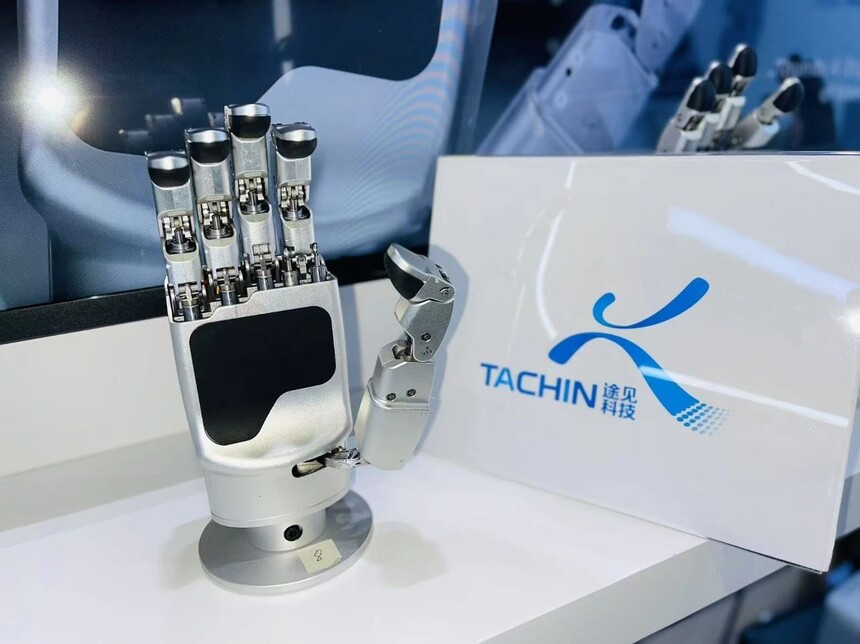 A nimble hand equipped with Tujian Technology's flexible electronic skin (Image source/Enterprise) In recent years, flexible electronic skin has surpassed the basic research and development stage and entered a rapid commercialization process. With the resolution of issues such as insufficient material consistency, signal crosstalk, and immature large-scale production processes, its functionality continues to be upgraded; Compared to the limitations of detecting only a single pressure or temperature signal in the past, multimodal perception fusion has now been achieved, which can simultaneously capture complex information such as pressure, temperature, material, and sliding. Currently, flexible electronic skin technology is in an important stage of transition from the laboratory to industrialization. For a long time, there have been several major application pain points in the field of flexible electronics. One is that the material lacks intrinsic stretchability, and its conductivity and sensing properties are prone to failure during stretching, which limits stable operation in complex dynamic environments; Secondly, due to the single modality and low integration of tactile sensors, it is difficult to achieve multimodal collaborative perception and support the multi-dimensional tactile needs of robots. Lai Jiancheng pointed out to Hard Krypton that although the robotics industry has developed rapidly in recent years, truly usable humanoid electronic skin products are still scarce, especially in application scenarios such as high dynamic deformation, large area coverage, and complex tactile perception. Existing technologies often fail to meet the needs of robots for high-order tactile feedback and intelligent interaction. When robots have the tactile perception ability of 'skin like', it may reshape the underlying logic of human-computer interaction. This process is not a scattered combination of sensors, but how to build a multimodal perception network that simulates human skin In view of the above-mentioned difficulties in implementation, Lai Jiancheng founded "Tujian Technology". Inspired by his research on the biological tactile mechanism during his time at Stanford, he developed a stretchable multimodal flexible electronic skin around the principle of human skin tactile perception, which has achieved independent innovation breakthroughs in both material and device ends. This electronic skin integrates a high-density sensor array, which can directly measure the real physical signals of the first contact surface such as pressure, temperature, shear stress, surface texture, and proximity sensation, covering full tactile information. Standard products can integrate 400 sensors per square centimeter, laboratory technology can reach 100000 sensors per square centimeter, spatial resolution of 0.5mm, laboratory technology can reach 30um, force resolution of 0.01N/cm ², measurement range of 0.1kPa-1MPa, maximum proximity perception distance of 20cm, sampling frequency of 1-1000Hz. The new generation of flexible electronic skin has broken through the technical barriers of traditional flexible devices that are difficult to integrate multimodal functions on a single chip, and has advantages such as high spatial resolution and high sensitivity perception, achieving true "biomimetic perception and feedback". At the same time, this product also has a service life of over 1 million times, as well as excellent characteristics such as impact resistance, waterproofing, anti-interference, and low power consumption. 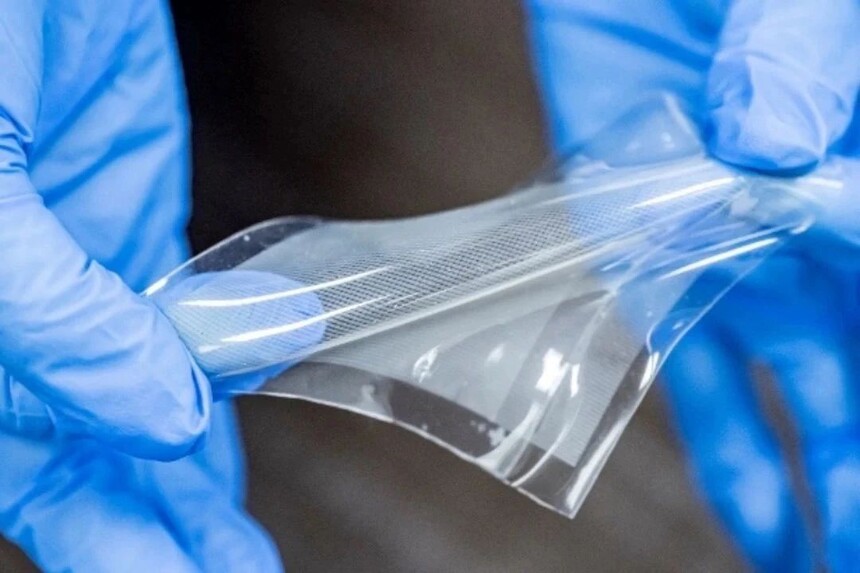 Electronic Skin Developed by Tujian Technology (Image Source/Enterprise) In the material layer, "Tujian Technology" has independently developed an intrinsic stretchable flexible material system. This system can maintain stable electrical properties under high stretchability conditions, with a stretchability of over 100% and a 100% recovery after stretching. The bendable radius is less than 5mm, making it suitable for various irregular non expandable surfaces without occupying internal space. The advantage of this stretchable property is that it can systematically solve the fundamental contradiction between material stretchability and electrical properties, providing a new material foundation for high-performance stretchable electronic skin. Taking the biomimetic dexterous hand ZWHUAND developed by the team in collaboration with Zhaowei Electromechanical as an example, it is equipped with the "Tujian Technology" flexible electronic skin tactile sensing system, which has a high sensing sensitivity of 0.01N/cm ² and a high sampling frequency of over 100Hz. Through high-density sensor arrays, precise recognition of object shape and material can be achieved, resulting in higher operational accuracy in specific scenarios. Its temperature sensing module also expands the environmental interaction dimension of dexterous hands. 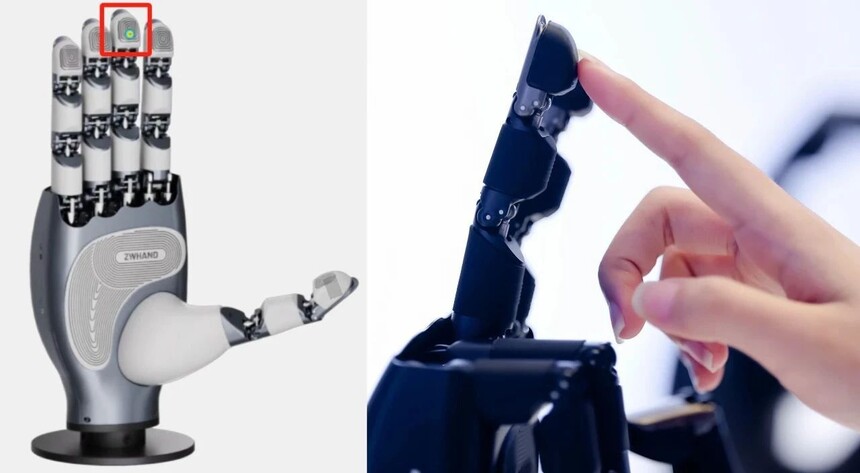 Biomimetic dexterous hand ZWHUAND (Image source/Enterprise) Hard Krypton has learned that "Tujian Technology" has reached cooperation agreements with multiple listed companies and leading car companies. In the future, it will focus on upgrading its multi scenario adaptation capabilities, accelerating product mass production and shipment, and establishing a large-scale supply chain system; And with intelligent robots, smart healthcare, automotive electronics and other fields as the core, further expand domestic and international markets, and promote the application and landing of flexible electronic skin technology in more terminal scenarios. |